What to expect after your FUE hair transplant

Please read this carefully. Following these instructions is essential for healthy healing and good results. If you have any questions, contact us:
Sinclair Dermatology: (03) 9654 2426 — Mon–Fri, 8:30 am–5 pm.
Mrs Shirley (Hair Transplant Coordinator): 0499 001 486 — Tue–Fri, 7 am–5 pm After hours: 0413 001 944.
Key rules from day one
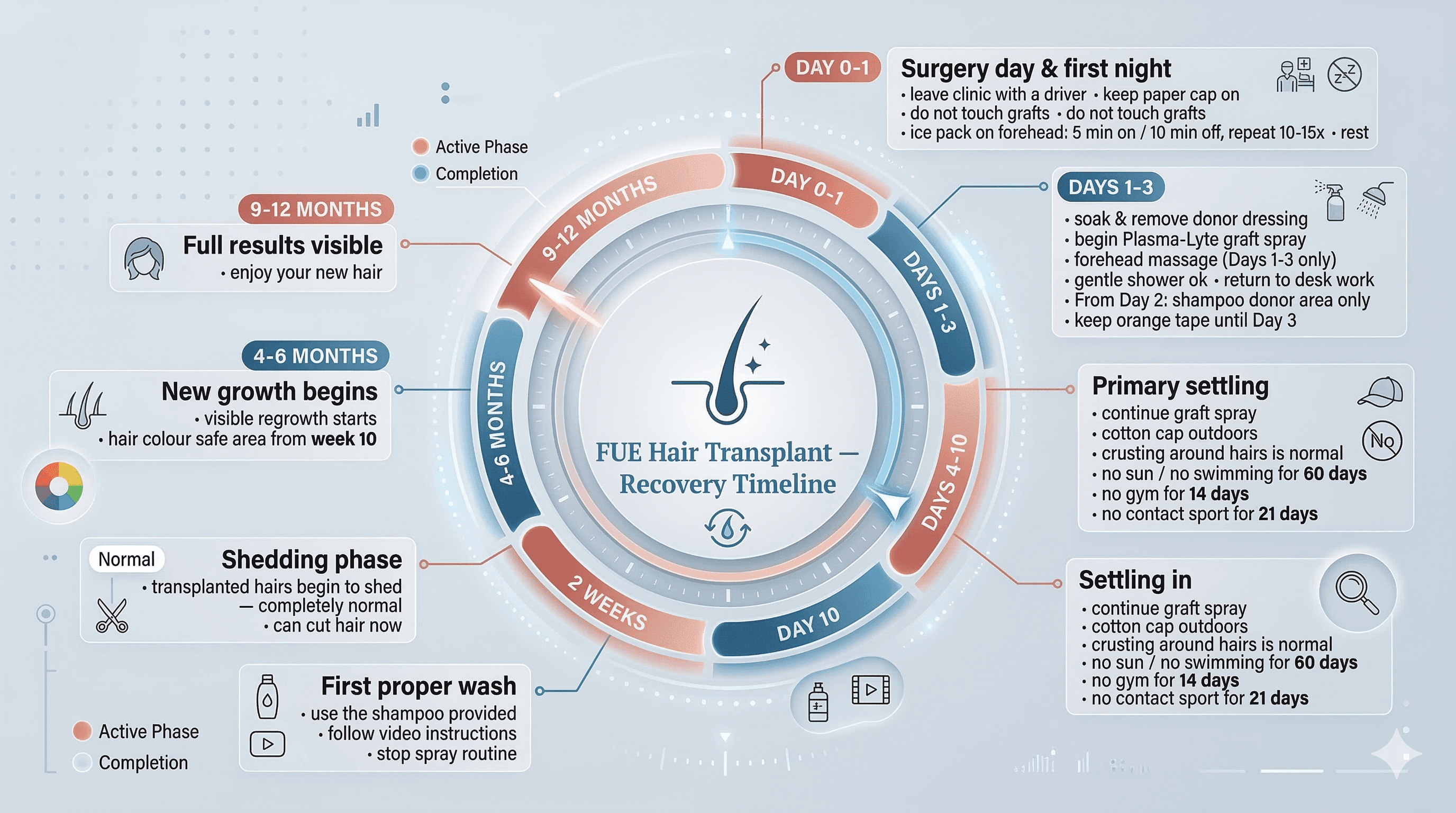
Do not touch, rub, or scratch the transplanted area. Nothing should be placed on the grafts for the first 7 days — no hats, caps, or beanies. After 7 days, a loose cap is fine; a tight one risks pulling out follicles when removed.
No sun exposure or swimming for a minimum of 60 days. No gym or physical activity for 2 weeks, no contact sports for 3 weeks, and avoid heavy lifting for a week after that.
Day of surgery — when you get home
There are no dietary restrictions, but avoid very spicy food.
Post-anaesthetic warning. You are still under the effects of medication. You must be driven home by a friend or family member, who should stay with you for the first 24 hours. Do not drive, operate machinery, sign documents, or make important decisions until the following day. You may feel faint — drink plenty of fluids, rise slowly, and avoid exertion. Rest; watching TV or listening to music is fine.
Grafts. Your grafts are at their most vulnerable today. Do not touch them. Keep your paper cap on and do not remove it.
Donor site. A dressing has been applied — leave it on overnight. It comes off the following morning.
Swelling. Apply the ice pack to your forehead: 5 minutes on, 10 minutes off, repeated 10–15 times. This reduces the risk of facial swelling.
Sleeping position. Sleep on a flat surface or with a thin, soft pillow for the first 5 days. Do not sleep face-down. Place the drape sheet provided on your pillow — some blood-stained oozing from the donor site overnight is normal. A travel pillow is a useful alternative, provided it does not contact the transplanted area.
Frontal transplant only: you may sleep on your back or sides.
Frontal + sideburns: sleep on your back only, not on your sides.
Frontal + crown/vertex: sleep on your back with the pillow lowered toward your neck; sides are also fine.
Frontal + crown + sideburns: sleep on your back with the pillow lowered toward your neck; do not sleep on your sides.
Medications
Take as directed by Dr Ragini Ghiya or your Hair Transplant Coordinator.
Mersyndol Forte (pain relief) — 2 tablets every 6 hours if required Temazepam (sleeping tablets) — 1 tablet at night if required Cefalexin (antibiotic) — 1 tablet twice daily for 10 doses total.
Day 1 after surgery
Have breakfast, then take your prescribed medication.
Remove the donor dressing. Soak it thoroughly with room-temperature water — pour it over gently or stand under a soft shower — until it slides off easily. Do not force it. Do not shampoo. Do not wipe the area; allow it to air dry. Apply the spare dressing provided if needed.
Begin graft spraying. Spray the grafts with the Plasma-Lyte solution according to your spray schedule. A moist environment aids healing and prevents scab formation. Apply your paper cap directly after spraying — there is no need to wipe first. You do not need to spray overnight.
Begin forehead massage. Press your fingers just above the orange tape and massage outward from the centre to the sides — 15–20 times per session, 5–6 sessions per day.
You may shower today using warm or cool water. Do not touch the grafts and do not wipe the area — allow it to air dry only.
You may return to desk work today.
Wear your paper cap outdoors. Indoors — at home, in the office, or in the car — you may leave your head uncovered.
Keep the orange forehead tape on for the next 2 days. Do not remove it; it prevents swelling from tracking down the face.
Day 2 after surgery
Gently shampoo the donor area only. If it feels itchy or uncomfortable, apply moisturiser.
Do not shampoo the implanted area and do not rub it — grafts need 10–11 days to establish in the skin, and rubbing before that may dislodge them.
If the implanted area itches, take Telfast up to twice daily and apply a light moisturising lotion — press it gently from the top of the head forward, leave it on, and do not massage.
Continue spraying the grafts. Keep the orange forehead tape on and continue forehead massage. Wear your paper cap outdoors.
Day 3
Today is the last day for the forehead massage. Continue spraying the grafts. Remove the orange forehead tape.
Days 4–10
Continue spraying the grafts with water. Wear the cotton cap outdoors. Take pain relief as needed. Some crust-like deposits around the new hairs are completely normal — leave them alone.
Day 10 — first proper wash
Begin washing your hair with the shampoo provided, following the video instructions carefully. Note: disregard any reference in the video to applying oil or moisturiser to soak the scabs — use the provided shampoo only. You no longer need to spray after Day 10.
After Day 10 and beyond
2 weeks — Transplanted hairs may begin to shed. This is entirely normal; the roots are firmly in place. You may cut your hair any time after the 2-week mark.
2 months — Small pimples may appear in the transplanted area as new hairs push through the skin. They typically resolve within a few days without pain or redness. Leave small ones alone; contact us if any are large or painful.
4–6 months — New hair growth begins and continues.
9–12 months — Full results are visible.
Common issues during the first 4 months
Pimples (donor scalp) — May appear for up to 4 months and subside on their own. Contact us only if they are painful.
Pimples (beard area) — May appear from around one week post-procedure, particularly around shaving days, and will come and go for 2–3 months before settling. Contact us if they are painful.
Pimples (recipient area) — Typically appear between 2–4 months as new hairs emerge and resolve on their own. Contact us if they are painful.
Itching and dryness — Apply moisturiser or oil as needed.
Pain — Some discomfort in the donor area is normal for up to one month and subsides on its own. Contact us if it persists beyond one month.
Numbness — May occur in the donor and recipient areas for up to 3 months and resolves naturally. No action is required.
Hair shedding — Most transplanted hairs may fall out by 2 months. This is normal. Regrowth begins around 4 months.
Additional guidelines
Sun exposure — Avoid direct sun for 2 weeks. After that, wear a cap until 3 months post-surgery.
Hair colour — Safe to use in the donor area from 4 weeks; safe in the recipient area from 10 weeks.
Haircuts — Fine any time after 2 weeks.
We wish you a speedy recovery and look forward to seeing your results.